
Hong Kong Top Talent Pass Visa
Hong Kong Top Talent Pass Scheme (TTPS): Categories A, B and C Explained
The Top Talent Pass Scheme (TTPS) lets high earners, graduates of top global universities, and experienced professionals secure a multi-year Hong Kong residence and work visa without a prior job offer or existing company. It is the fastest-to-obtain of Hong Kong’s major immigration routes, though renewal now requires proof of genuine local economic activity.
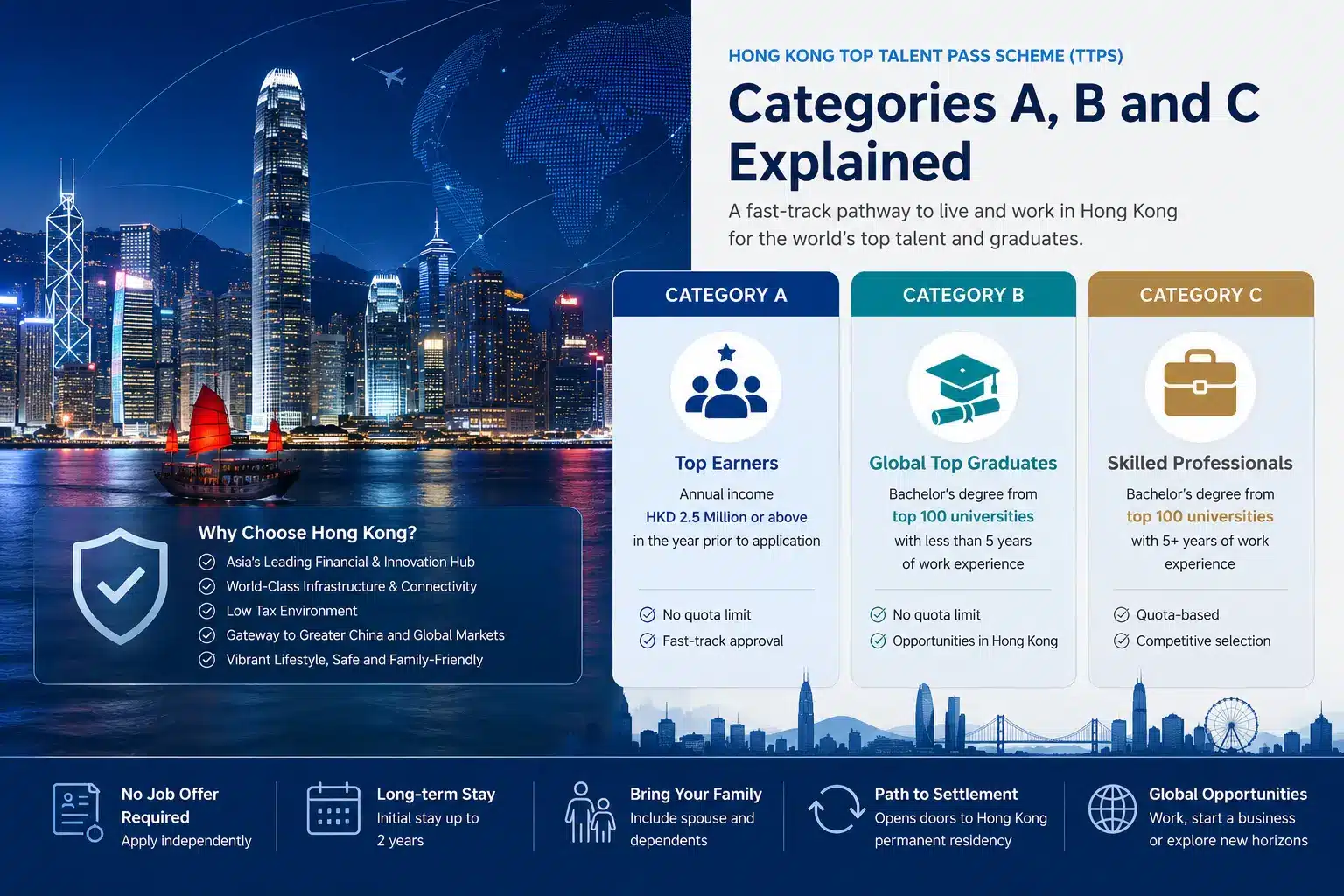
The Three TTPS Categories
| Category | Who it’s for | Core requirement |
|---|---|---|
| Category A | High earners | Annual taxable income of at least HK$2.5 million in the preceding 12 months |
| Category B | Experienced professionals | Bachelor’s degree from an eligible university (per the government’s Aggregate List) plus 3+ years of post-graduation work experience within the last 5 years |
| Category C | Recent graduates | Degree from an eligible university, under 3 years of work experience; capped at 10,000 places per year, first-come first-served |
Category A: Income Requirements in Detail
- Income must be taxable employment or business income (salary, allowances, stock options, documented distributions from self-owned enterprises).
- Passive investment income, capital gains, and non-taxable asset transfers do not count.
- Applicants must submit official tax assessment notices from a competent national revenue authority — internal company letters or accounts are not sufficient.
- Category A has no educational requirement, making it well-suited to entrepreneurs and business founders without a formal degree.
Categories B and C: Academic Requirements in Detail
- The degree must come from an institution on the government’s Aggregate List of Eligible Universities, which tracks QS, Times Higher Education, and Academic Ranking of World Universities rankings.
- A master’s or doctorate cannot substitute for a non-qualifying bachelor’s degree — the undergraduate institution must itself be on the list.
- Independent third-party qualification authentication reports are required at the initial application stage.
- Category B work experience is cross-checked against employment contracts, tax records, and social security filings.
Initial Stay and Work Rights
| Category | Initial stay | Work rights |
|---|---|---|
| A | 3 years | Unrestricted — start a business, take employment, or switch employers freely |
| B / C | 2 years | Unrestricted — same open work-permit conditions as Category A |
The Renewal Challenge: Proving Genuine Economic Integration
This is the part advisors most need to plan for. TTPS extensions run on a three-plus-three-year cycle, but approval depends on demonstrating a genuine economic footprint in Hong Kong by the renewal date — either:
- Bona fide local employment commensurate with degree-holder status at market-rate pay, or
- An established, substantive commercial business in Hong Kong.
The Immigration Department actively screens out nominal or contrived employment by examining Mandatory Provident Fund (MPF) contributions, corporate tax returns, commercial leases, and local hiring evidence. Treat the initial visa term as an active implementation window, not a passive holding period — a lack of tangible local economic contribution at the renewal milestone will result in refusal.
Many TTPS holders satisfy the renewal test by starting their own Hong Kong company rather than seeking local employment. If that’s your plan, see our guide to Hong Kong company formation and bank account setup.
Professional Service Fees
| Item | Cost (USD) |
|---|---|
| Main applicant | $4,000 |
| Each dependant | $2,000 |
| Government fee | $250 per passport |
Frequently Asked Questions
Related: Compare all Hong Kong immigration programs → | New CIES Investment Visa → | Entrepreneur Visa → | Hong Kong Company Formation & Bank Account Setup →